 Bambui Foondon
Culture, Government & Indigenous Political Organization
Bambui's culture, government, and political system centre on the Fon or Mfor, the sub-chiefs or taah and the kwifor, which is a secret society that represents the entire population of the kingdom. The Fon and kwifor have overriding powers, but the Fon can be disciplined by Kwifor. The Fon in particular has multifarious functions involving the domestic as well as the external affairs of the kingdom. Domestically, he oversees the making and execution of the laws of the land and remains the final court of appeal for unresolved matters. As chief priest, he oversees the offering of sacrifices to the gods and ancestors of the kingdom and intercedes with them for the welfare of the people. He presides at important festivals, the most important being the end of year Mandele or the Fon's dance. Externally, the Fon represents the kingdom at all important political, economic and cultural forums. He, in fact, is the mouthpiece of the kingdom; and his word is almost law that could make or mar the kingdom.
The Fon is assisted and advised by sub-chiefs, nobles, and titled royals. The most prominent among them are the Muefor, the mother of the Fon or a sister that represents her and three fraternal assistants called Mofor, Idifor and Tabefor. However, none of these royal advisers serves as regent if the Fon is indisposed.
The Kwifor which has its own “natural” and appointed nobles has, at least in theory, far more pervasive powers than the Fon. Membership is restricted to commoners who have undergone some ritualistic initiation. The Kwifor is the institution that actually chooses and enthrones the Fon. Thus, in its role as the council of kingmakers, kwifor checks on royal power. The Fon is very much aware of this role and does everything possible to avoid confrontation with Kwifor. Also, as the institution with the most pervasive powers, kwifor oversees the investigation and judgment of cases involving, for example, witchcraft and/or murder.
Although the sub-chiefs assist the Fon in the administration of the kingdom, their powers are much more restricted at the levels of their clans or family groups and the neighborhood or “quarter.” Sub-chiefs as well as some nobles inherit their positions from their parents or through a lineage system. The current five sub-chiefs of the kingdom are:
-Formanju (chief of Manju quarter or neighborhood)
-Formallam (chief of Mallam quarter)
-Formatula-ah (chief of Matula-ah quarter)
-Forala-akuba (chief of Ala-akuba quarter)
-Forfengih (chief of Fengih quarter)
The government and indigenous political system of Bambui is therefore a complex web of kingship, chiefs, nobles and an all pervasive secret society.
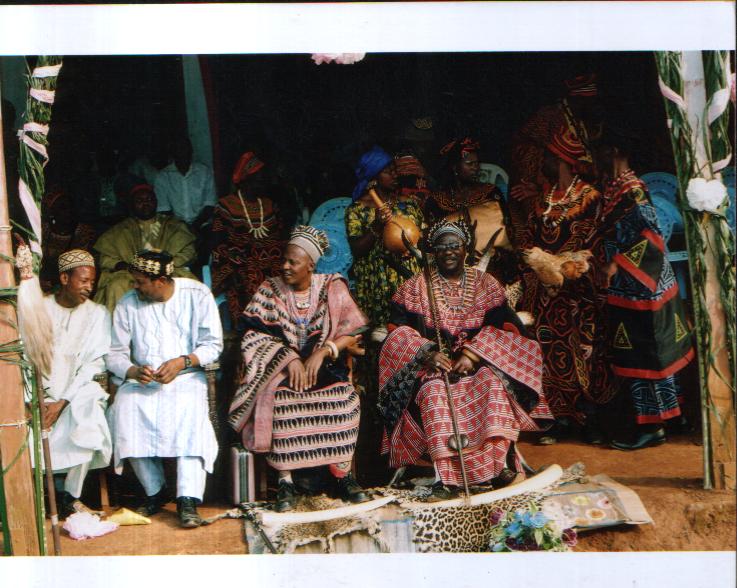
The Fon of Bambui with sub-chiefs and nobles.
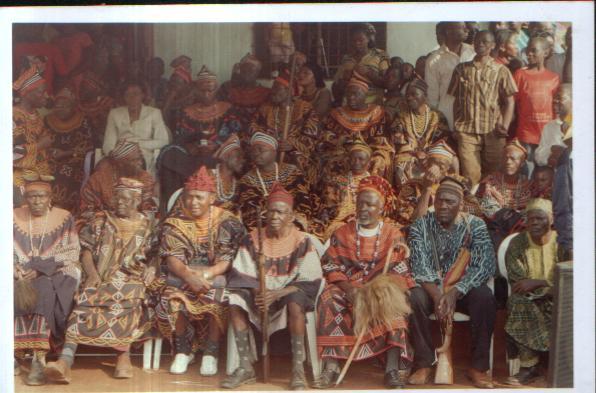
A cross-section of Sub-chiefs and nobles during the 2010 (Mandele) annual dance.
.
List of Fons and Queens in order of succession:
Foh Zetingong
Foh Lungsi
Foh Suhnie